Safety analysis, structured from hazard to control
Identify hazards, assess risk with industry-standard scales, and document the controls that bring it to acceptable levels, all traced back to your architecture and requirements.
Book a demoHow it works
Four steps from the first hazard to a risk your program can sign off.
Capture every hazard
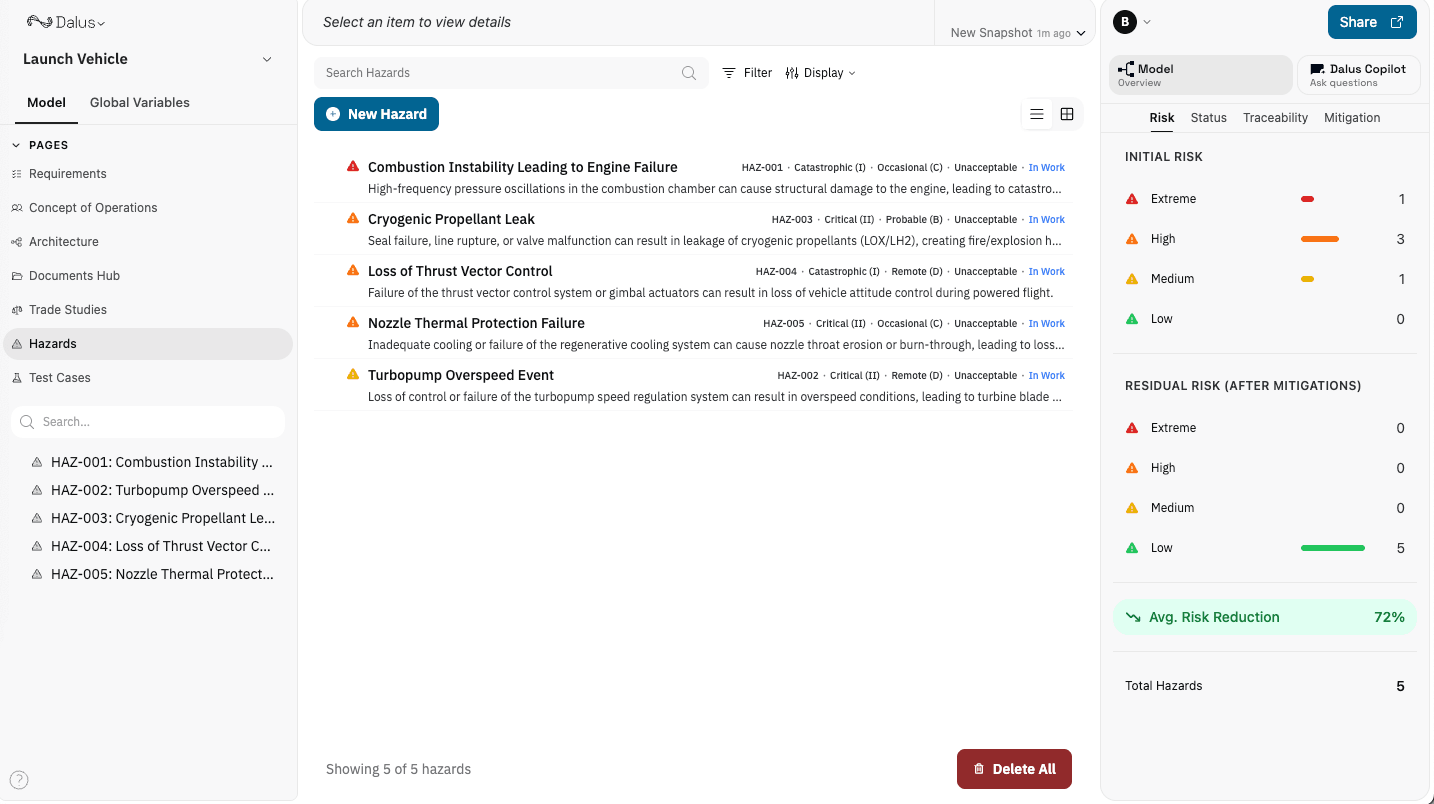
List hazards with an ID, a description and the potential harm, in one place for the whole program. The overview shows how many sit at each risk level, before and after mitigation.
Assess the risk
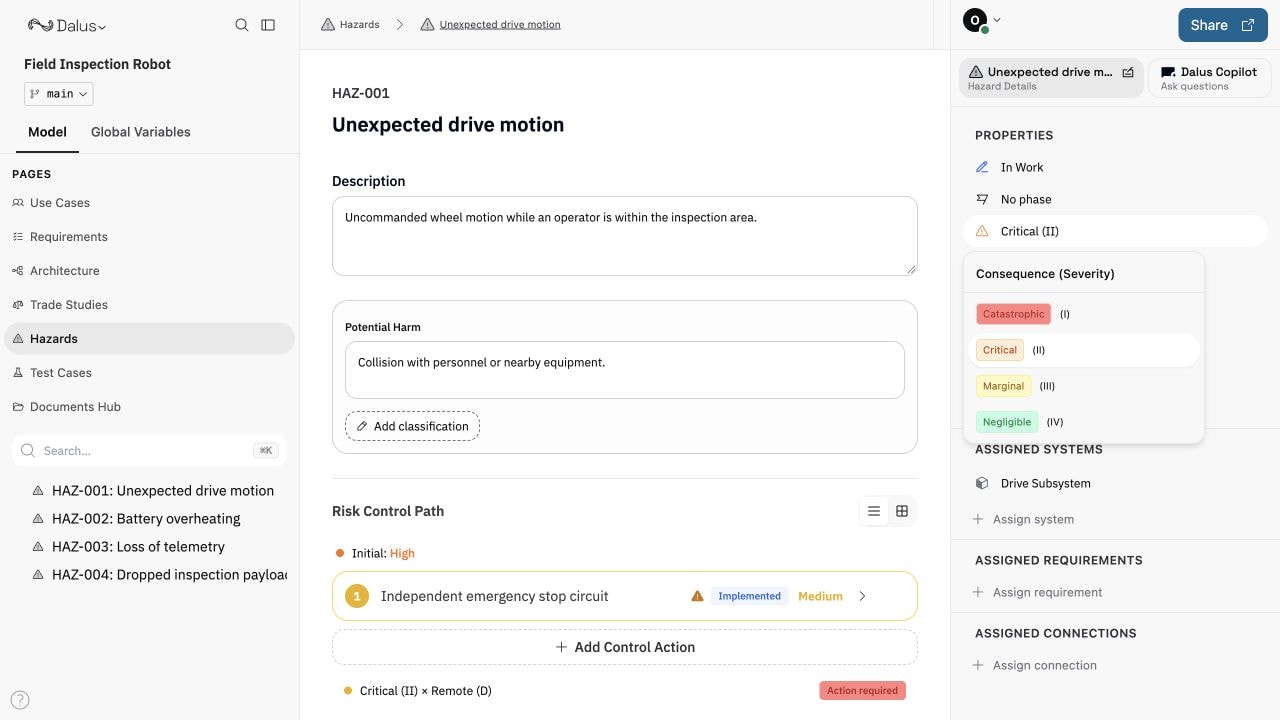
Rate each hazard's severity and likelihood on the MIL-STD-882E scales. Dalus turns the pair into a risk level from low to extreme and flags anything that needs action.
Add controls and see the risk drop
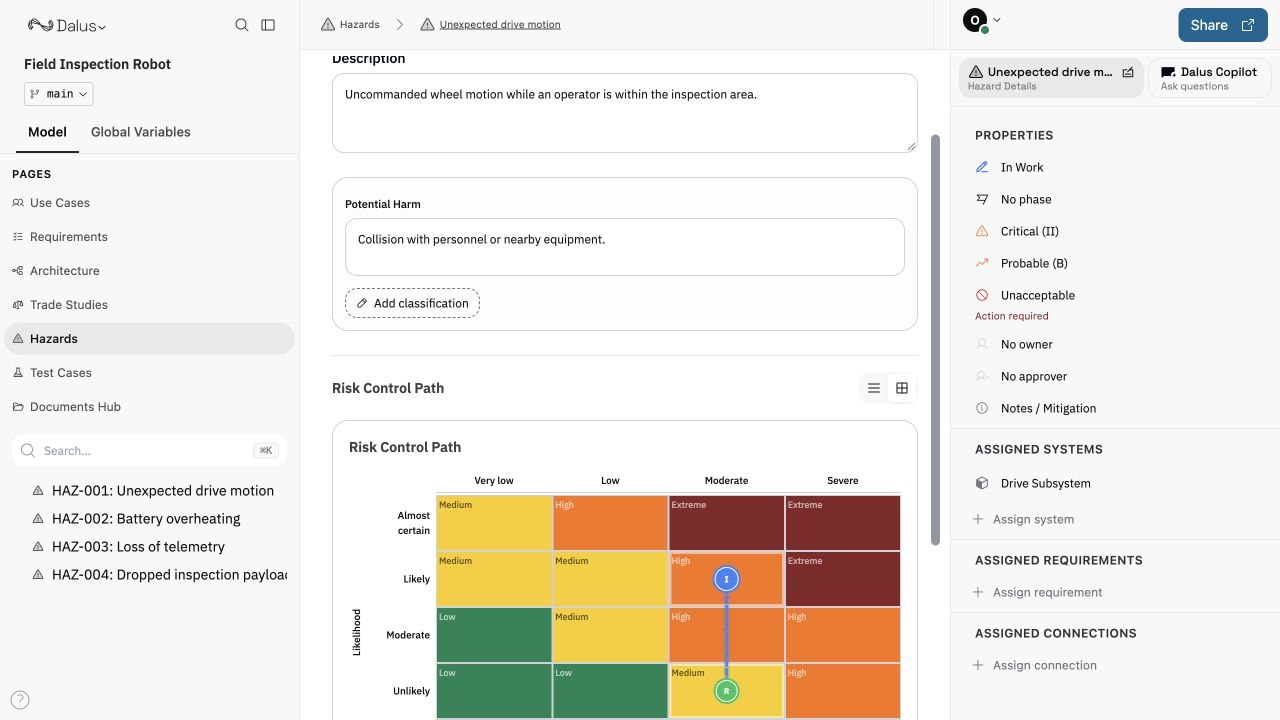
Add control actions in order of the hierarchy of controls, from elimination to training. The risk control path shows how each one moves the hazard from its initial to its residual risk.
Track risk across the program
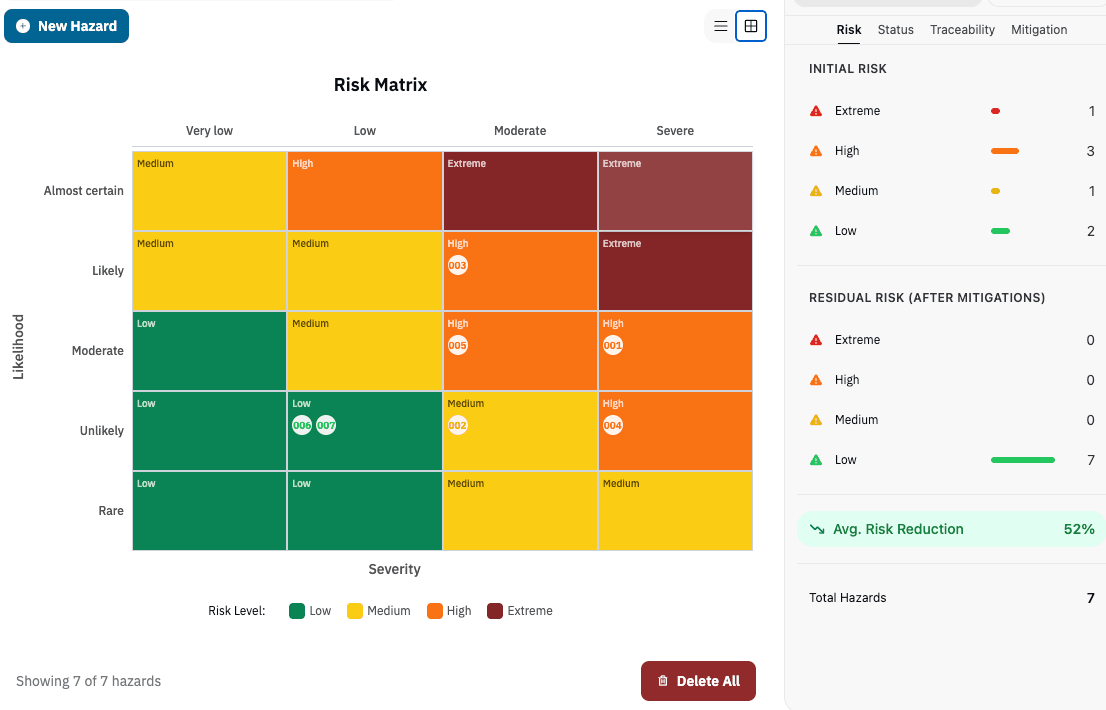
The risk matrix places every hazard by its residual risk, so reviews start from the full picture. Record who accepted each remaining risk, when and why.
Key capabilities
- Risk matrix visualization with mitigation paths
- Severity and likelihood assessment
- Control hierarchy tracking (elimination to training)
- Traceability to parts, interfaces, and requirements
- Control verification and evidence documentation
- Risk disposition and acceptance workflows
Connected to the rest of your model
A hazard log in a spreadsheet can't tell you what a design change affects. In Dalus, hazards link to the parts that cause them, the requirements that control them and the tests that prove those controls work.
Let Copilot do the first draft
Dalus Copilot works on the same model. Ask it to set things up, fill gaps or check your work, then review what it changed.
More about Dalus Copilot
“Dalus helped us bring structure and traceability to our IoT system development”

Matthias Priebe
Systems Engineer, IOX Lab
- 10xfaster requirements reviews
- 0spreadsheets left
- 3xfaster customer sign-off
Explore other features
- Learn more
System Architecture
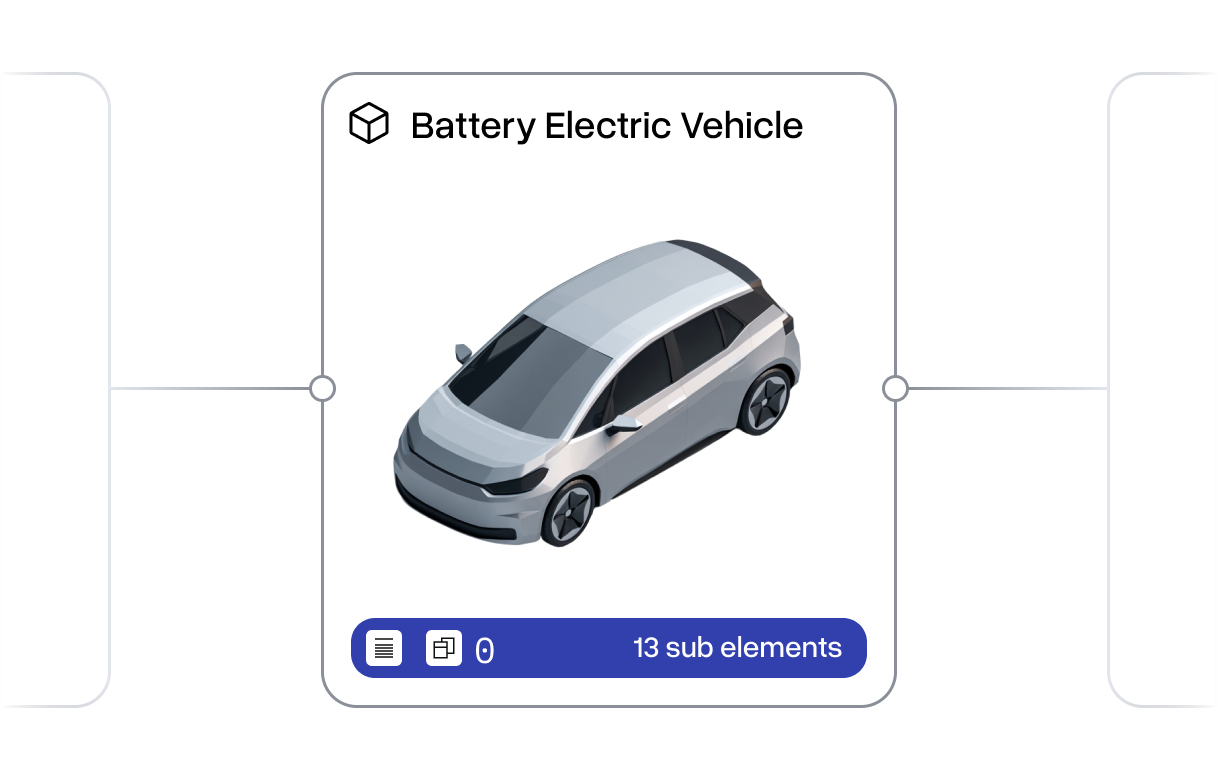
Decompose your system into subsystems, parts, and interfaces for your structural architecture.
- Learn more
Requirements Management
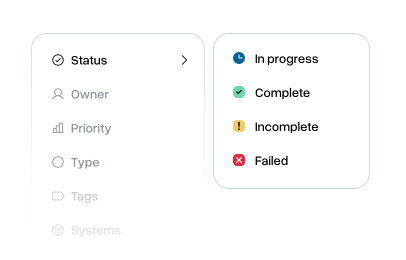
Stay on top of requirements by tracking statuses, assigning engineers, and ensuring real-time updates.
- Learn more
Mission planning
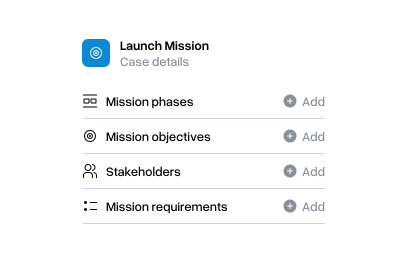
Define missions and use cases, manage stakeholders, and track program phases from concept to disposal.
- Learn more
Test Cases
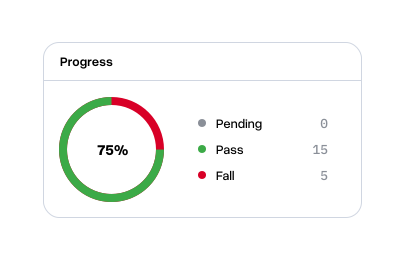
Plan, execute, and track verification and validation tests with step-by-step procedures and full traceability.
- Learn more
Analysis & Verification
Verify your requirements by tightly coupling behavior and simulation. Run Python scripts for different states and functions.
FAQs
Everything you need to know before you get started.
Every hazard gets a severity and a likelihood on the MIL-STD-882E scales: four severity levels from negligible to catastrophic and five likelihood levels from improbable to frequent. Together they set a risk level of low, medium, high or extreme, and the matrix view plots each hazard's residual risk.
Can’t find what you’re looking for?
Contact us

Let’s discuss your
systems engineering challenges
Tell us what you’re building, and we’ll show you how Dalus can help.

30-minute discovery call with Sebastian
Co-founder, Dalus
No time that works? Send us a message and we’ll find one.